Pravision® Officially Registered

A New Milestone in Our Journey

We’re happy to share some exciting news! Pravision® is now an officially registered trademark with the United States Patent and Trademark Office (USPTO)!

This is a special moment for us and an important milestone in our journey.

What started with an idea and a name has grown into something we continue to build and believe in every day. Seeing Pravision officially registered as a trademark makes this achievement even more meaningful.

Pravision Is More Than Just a Name

Pravision is not just a name. It represents our work, our ideas, the challenges we’ve faced, the lessons we’ve learned, and everything we hope to accomplish.

It reflects our belief in looking beyond what exists today and imagining what could be possible tomorrow.

For us, Pravision means bringing vision to life, seeing tomorrow’s possibilities today, and finding ways to make them real.

Every project we take on and every solution we create is part of that journey. Some ideas come to life quickly, while others take time, patience, and determination. Each one teaches us something and helps us move forward.

Having our trademark officially registered is an important step in protecting the identity we’ve worked to build.

Helping Businesses with What Matters Every Day

At Pravision, we believe every business deserves access to technology and support that makes running a business easier, regardless of its size.

Whether it’s a one-person business, a small local shop, a growing company, or a mid-sized organization, each has its own challenges, responsibilities, and goals.

We understand that business owners often manage many things at once. From daily operations and customer relationships to scheduling, managing information, maintaining an online presence, and finding new opportunities, even the smallest tasks can take valuable time.

Our goal is to help businesses simplify their everyday work, manage their operations more efficiently, and focus on what matters most to them.

We want technology to be practical, accessible, and useful, not something that adds more complexity to an already busy day.

For us, helping a small business save time or making daily work easier for a growing team is just as meaningful as building a larger solution.

Every business matters, no matter how small it starts.

Looking Back and Moving Forward

Building a company comes with its share of challenges, decisions, and unexpected turns. There are moments when things go as planned and others when we have to find a different way forward.

Through it all, we keep learning, improving, and building.

This trademark registration is one of those achievements that makes us stop for a moment, look back at how far we’ve come, and feel proud of the progress we’ve made.

While our name now carries the ® symbol, what matters most to us hasn’t changed. We remain committed to creating useful solutions, doing meaningful work, and earning the trust of the people and businesses we serve.

There is still much more ahead of us, and we’re excited to keep going.

Thank You for Being Part of Our Journey

We want to thank everyone who has supported Pravision, worked with us, trusted our services, or encouraged us along the way.

Every conversation, opportunity, and word of encouragement has meant something to us.

We’re grateful for the support we’ve received and proud to share this milestone with everyone who has been part of our journey.

Official Trademark Registration

The PRAVISION wordmark is officially registered with the United States Patent and Trademark Office (USPTO).

The registration covers Software as a Service (SaaS) services under International Class 042.

This recognition is an important step in protecting the Pravision brand as we continue developing technology solutions and supporting businesses with their everyday needs.

Trademark Details

  • Registered Wordmark: PRAVISION

  • Registration Status: LIVE, REGISTERED

  • USPTO Serial Number: 99629639

  • International Class: 042

  • Goods and Services: Software as a Service (SaaS)

  • Trademark Authority: United States Patent and Trademark Office (USPTO)

View Pravision’s Official USPTO Trademark Record

The Journey Continues

This registration is an achievement worth celebrating, but it is also a reminder that we’re still building, still learning, and still working toward what comes next.

We started with a name and an idea. Today, that name is officially registered, and the story behind it continues to grow.

Our commitment remains simple: to help businesses, from the smallest independent operations to growing organizations, make better use of technology and spend more time on what matters to them.

Pravision® | Where vision meets its perfect fit.

Here’s to how far we’ve come and everything still to come.

The Seasons of Life: An Anchor, a Universe, a Light, and a Sky

Some stories are not written with words. They are written through changing seasons, unexpected storms, quiet sacrifices, and the love that holds a family together.

A November Memory

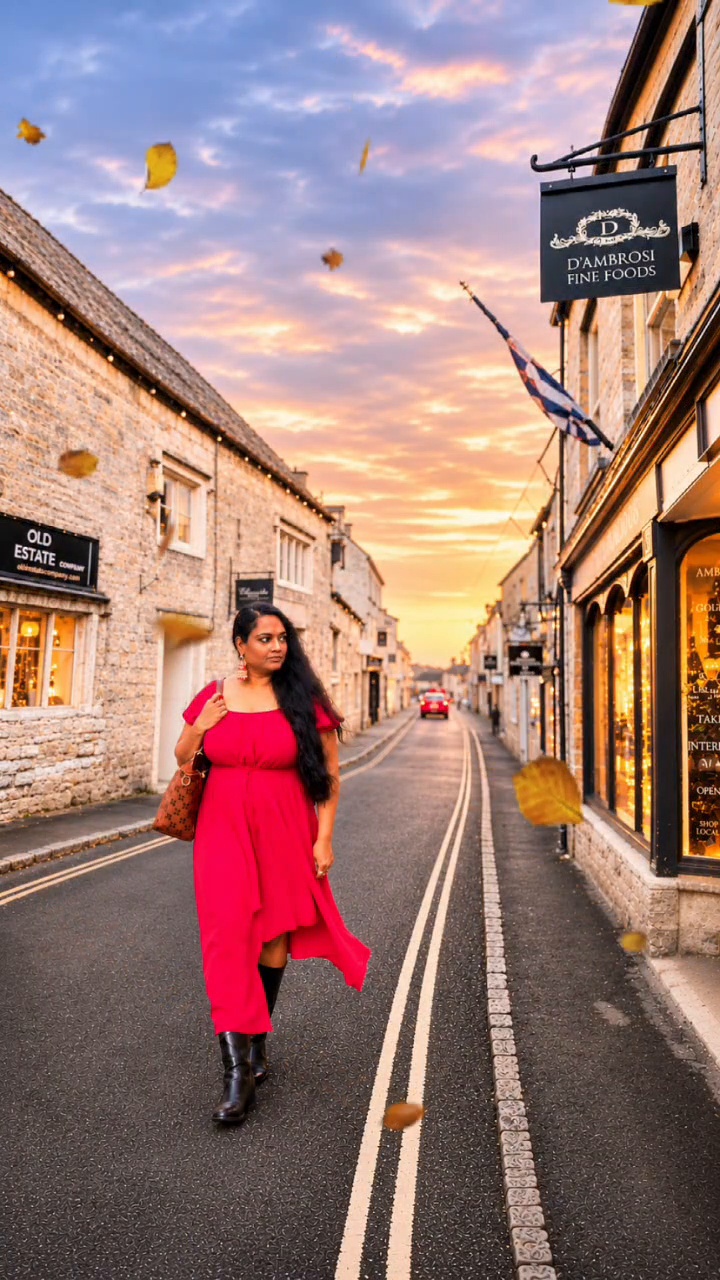
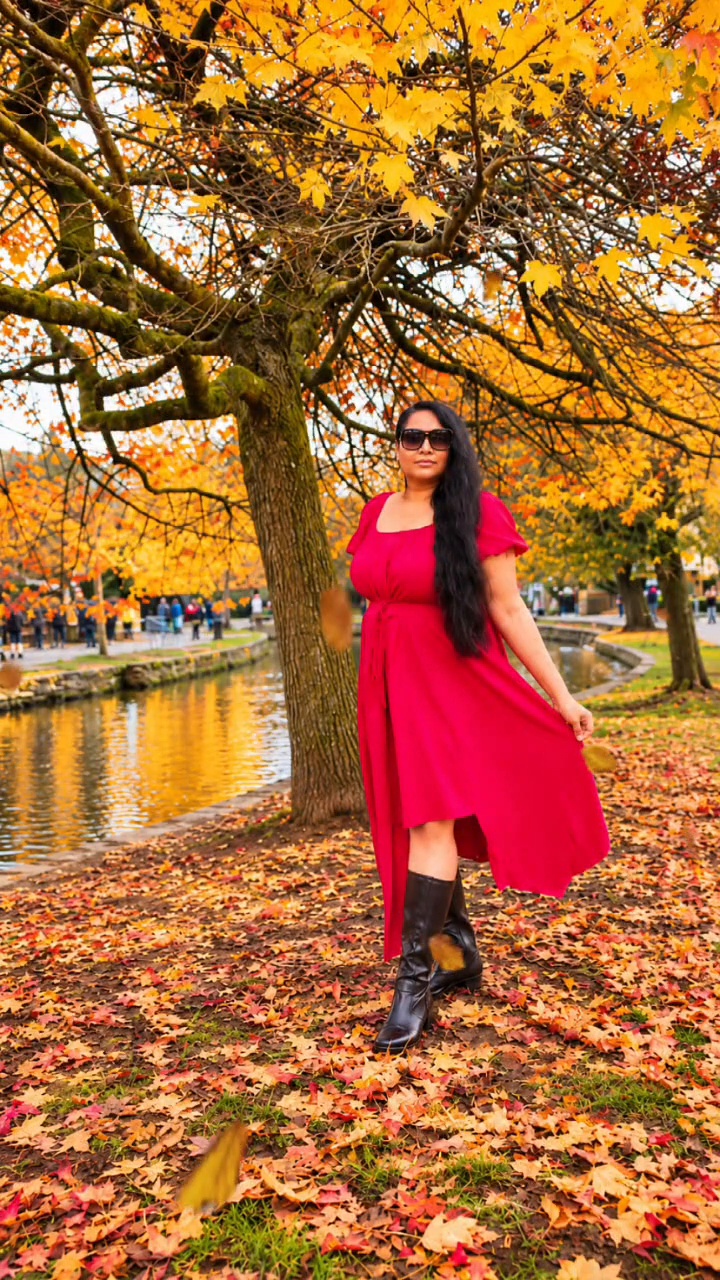
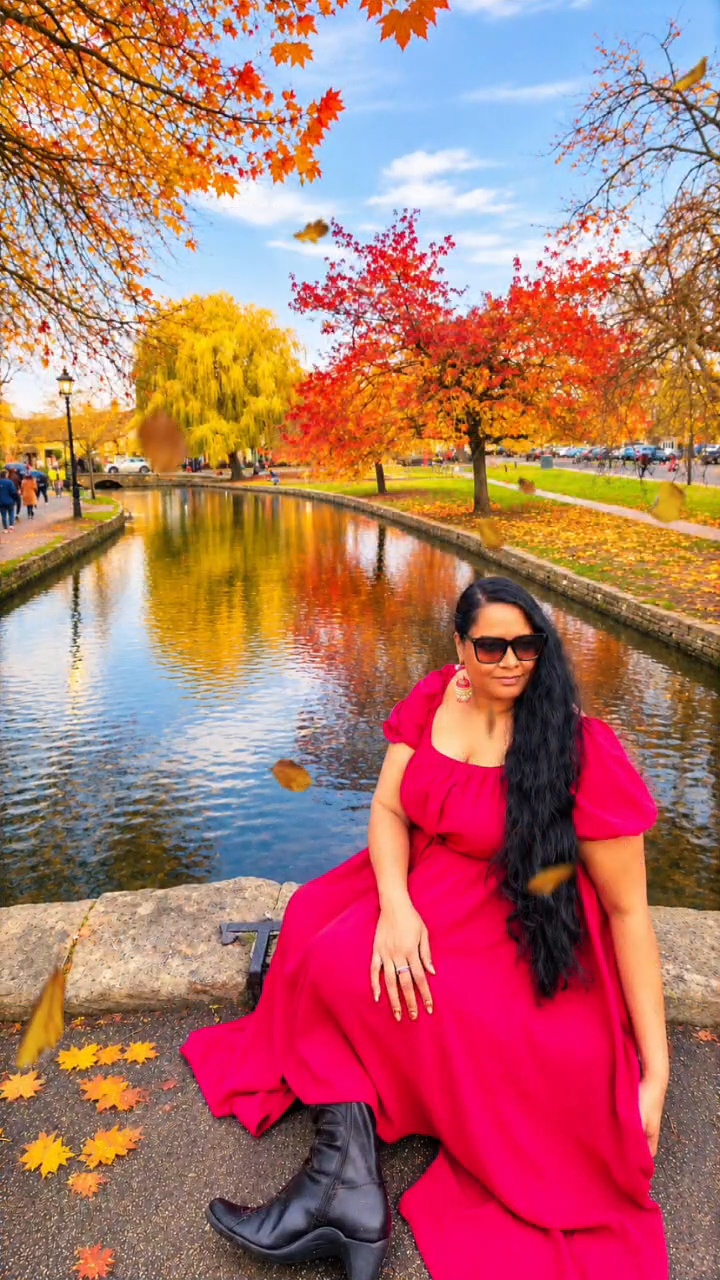
Four years ago, in November, I walked through the beautiful autumn streets of London, surrounded by falling leaves and the colors of a season that has always held a special place in my heart. At the time, they were simply photographs capturing beautiful moments during a visit. But looking at them today, I see something much deeper. Every falling leaf reminds me of a passing year, every changing color brings back a memory, and every quiet moment takes me through the journey of a family that has grown through love, happiness, sorrow, and countless new beginnings.

Praveena In London#PraveenaAneNenu
A November afternoon in London, where the falling leaves captured a beautiful moment, unaware of the memories they would awaken years later.

These photographs may belong to one November in London, but the memories they awaken belong to a lifetime.

And this is where the story begins.

There is something about November that brings memories closer to the heart. Perhaps it is the changing colors of the leaves, the gentle chill in the air, or the way autumn makes us look back at the years that have passed. As the leaves turn golden and slowly find their way to the ground, they remind us that life is constantly changing, that every season has its own purpose, and that even the most beautiful things must sometimes change to make room for something new.

Every family has a story, but not every story begins with a grand celebration or a perfect plan. Some begin quietly, with two individuals whose paths cross at just the right moment, unaware that their meeting will eventually become the foundation of an entire world.

This particular story began in November, when the first chapter of a family was written. There was an Anchor, steady and grounded, and a Universe, filled with dreams, emotions, curiosity, and endless possibilities. They came from different journeys, carrying their own experiences and expectations, without knowing how deeply their lives would become connected.

March brought another meaningful turn in their story, and by May, the Anchor and the Universe had joined hands to begin a life together. They did not have all the answers, nor could they see everything waiting for them along the road, but they had something far more important than certainty. They had the willingness to build a future together, to learn from one another, and to face whatever life placed before them.

Their journey took them far beyond the places they had once called home. A new country welcomed them with unfamiliar surroundings, different ways of living, and countless things to learn. Then came another move, another state, another beginning, and the challenge of building a life while continuing their education and pursuing their dreams.

Those years were filled with responsibilities, adjustments, hard work, and the quiet sacrifices that rarely become part of the stories people tell. There were days when everything seemed possible and others when even the smallest progress required enormous patience. Yet through it all, the Anchor and the Universe were learning one of life’s most valuable lessons: a home is not defined by the country we live in, the house we own, or the things we accumulate, but by the love, trust, and understanding we build within it.

Slowly, life began to find its rhythm. There were ordinary mornings, busy afternoons, conversations about tomorrow, small celebrations, shared dreams, and moments of laughter that made even the most tiring days worthwhile. From the outside, it was simply another happy family building a future, much like the countless families we see around us every day.

But happiness, however beautiful, does not come with a promise that sorrow will never knock on the door.

Sometimes life sends an unexpected wind, one that arrives without warning and changes the direction of everything we thought we understood. It does not wait until we are ready, nor does it consider how carefully we have built our dreams. It simply blows through our world, shaking the strongest branches and carrying away pieces of happiness that we believed would remain forever.

For the Anchor and the Universe, such a wind arrived, leaving behind a silence that neither had imagined. There are certain sorrows that cannot be measured in words, experiences that change the way we look at life and leave memories that time may soften but never completely erase.

Even the strongest Anchor can feel shaken, and even a Universe filled with countless stars can experience moments of darkness. Yet somewhere within that darkness, the smallest hope can begin to grow, quietly reminding us that the story of life is not finished simply because one chapter has been painful.

And then, when life seemed to need a little magic, a Light arrived.

A beautiful, precious Light that brought warmth into the family and slowly filled its days with a happiness that felt both new and deeply comforting. This Light did not come to erase sorrow or replace anything that had been lost, because love does not work that way. Instead, the Light brought a new reason to smile, another reason to believe in tomorrow, and the gentle reminder that even after difficult seasons, life still has the power to surprise us with extraordinary blessings.

The unexpected wind that had once shaken their world could not extinguish this Light. Its presence gave the Anchor renewed strength and filled the Universe with colors that seemed to have been waiting patiently to return.

Praveena In London#PraveenaAneNenu
Every leaf has its season, every season has its story, and every story carries a little light that never truly fades.

There was laughter again, a different kind of excitement in the home, and countless little moments that became precious without anyone realizing their importance. Every new discovery, every small achievement, and every passing day became part of a beautiful journey that the Anchor and the Universe wanted to hold close forever.

But time has its own way of moving, never asking us whether we are ready for the next chapter.

Days became months, months turned into years, and the years passed so quickly that it sometimes felt as though an entire season had disappeared in the blink of an eye. The little Light continued to grow, bringing new adventures, questions, dreams, and responsibilities, while the Anchor and the Universe discovered that raising a family meant growing alongside it.

They began to understand that love was not simply about creating happiness. It was also about protecting it, nurturing it, and giving it enough freedom to discover its own strength.

A Light needs warmth and care, but it also needs space to shine. It needs a world where it can grow without fear, where dreams can stretch beyond familiar boundaries, and where even the most difficult days are met with understanding and encouragement.

Perhaps life understood that the growing Light deserved something more, something peaceful and limitless, something that could share its journey while bringing another kind of happiness into the family.

And then came the Sky.

Quiet, gentle, and beautiful in a way that was entirely its own, the Sky arrived like another blessing, bringing a sense of calm and completeness to a family that had already traveled through so many seasons.

The Sky was never meant to take the Light’s place, just as the Light had never been meant to replace the happiness that came before. Each carried a different kind of magic, a different personality, and a different purpose within the family.

The Light brought its own brightness, and the Sky brought its own peaceful wonder. Together, they filled the home with two kinds of happiness, reminding the Anchor and the Universe that love does not become smaller when it is shared. It grows, expands, and finds new ways to make room for everyone.

There were now two beautiful lives to nurture, two different worlds to understand, and countless dreams waiting to unfold. The Anchor and the Universe knew that they could not protect the Light and the Sky from every difficulty the future might bring, but they could give them something lasting: strong roots, the confidence to stand on their own, and the certainty that they would always have a place where they belonged.

As the family grew, life continued in its familiar, beautiful, imperfect way. There were school days, celebrations, responsibilities, disagreements, laughter, lessons, and countless conversations that would one day become memories. There were moments of pride and moments of worry, days filled with excitement and days when simply being together was enough.

To the outside world, they were an ordinary family living an ordinary life. But perhaps that is where the greatest beauty of family truly exists, not in extraordinary events or perfect photographs, but in the everyday moments that quietly build a lifetime of love.

A family is not held together because everyone thinks alike or because life always moves according to plan. It is held together through patience when understanding is difficult, forgiveness when mistakes are made, encouragement when confidence begins to fade, and the willingness to remain connected even as each person grows into someone different.

The Anchor continued to provide strength, the Universe continued to hold countless dreams and emotions, the Light found new ways to shine, and the Sky began stretching toward its own horizons.

And just like that, another year passed, and then another.

The seasons continued their familiar dance. Spring arrived with new beginnings, summer brought warmth and energy, autumn painted the world in beautiful colors, and winter reminded everyone that even the quietest days have something to teach us.

Praveena In London#PraveenaAneNenu
Four years have passed since this November in London, yet some moments remain untouched by time, quietly reminding us how far life has carried us.

With every passing season, the family changed. The little ones were no longer quite so little, the dreams that once seemed distant began taking shape, and the Anchor and the Universe slowly realized that the years they had once imagined were becoming the memories they now treasured.

There is something both beautiful and bittersweet about watching a family grow. We spend so much of our lives looking forward to the next milestone, the next achievement, the next celebration, that we sometimes forget to appreciate the ordinary day unfolding right in front of us.

We wait for the children to grow, and then wish we could hold on to their childhood a little longer. We work hard to build a comfortable future, only to discover that some of our happiest memories came from the simplest days when we had very little except one another.

Perhaps that is one of life’s greatest lessons. Happiness is not something waiting for us at the end of a long journey. It is scattered throughout the journey itself, hidden in familiar voices, shared meals, unexpected laughter, warm embraces, and the quiet comfort of knowing that somewhere in this enormous world, there are people who call us family.

And now November has returned.

The leaves are changing colors again, and the autumn breeze carries the same familiar reminder that nothing in life remains exactly as it was. The trees release their leaves without knowing what the next season will bring, yet their roots remain firmly planted, trusting that spring will eventually return.

A family is much like those trees. Its branches grow in different directions, its leaves change with the seasons, and sometimes unexpected winds test its strength. But when its roots are built on love, trust, sacrifice, and understanding, it can continue growing through even the most difficult seasons.

The Anchor may grow older, the Universe may carry more memories, the Light may discover new places to shine, and the Sky may stretch toward possibilities that no one can yet imagine. Their paths may not always remain close, and life may lead them toward different dreams, but the bond that connects them can remain stronger than distance, time, or change.

Because the purpose of a family is not to keep everyone in the same place forever. It is to give each person enough love to grow, enough courage to explore, and enough confidence to know that wherever life takes them, they will never be without roots.

The story that began in November was never about creating a perfect life. It was about two people learning to build something meaningful together, discovering strength through unexpected sorrow, welcoming happiness when it returned, and watching that happiness grow into two beautiful lives.

It was about an Anchor who stood steady through changing tides, a Light that reminded the family of hope, and a Sky that brought another beautiful dimension to their world.

And it was about a Universe that held all these seasons within her, carrying the memories of where the journey began, the pain of the storms, the joy of new beginnings, and the quiet gratitude that comes from looking back and realizing how much love has filled the years.

There will be more autumns, more changing leaves, more milestones, and perhaps more unexpected winds. No one knows what the coming seasons will bring, but the most important thing is not being able to predict the future. It is knowing that the love built through the years has given everyone the strength to face it.

As the autumn leaves drift gently through the air, this story may sound like the story of any family. A story of two people who began with dreams, traveled through unfamiliar places, faced unexpected sorrow, and found their greatest happiness in the lives they created together.

But every word carries a memory, every season holds an emotion, and every chapter belongs to a journey that is still being written.

Praveena In London #PraveenaAneNenu
Among the changing colors of autumn, a Universe pauses to appreciate the seasons she has lived, the storms she has weathered, and the love that makes her world complete.

And perhaps it is time to reveal why this story feels so close to the heart.

I have watched the Anchor stand strong when life was uncertain. I have felt the warmth of the Light when the world seemed dark, and I have watched the Sky bring its own quiet beauty into our lives. I have lived through the changing seasons, carried the memories of the unexpected winds, and treasured the happiness that followed.

This is not simply a story I heard, or a family I watched from a distance. This is the life I have lived, the love I have carried, and the family that means everything to me.


I am the Universe.

And if there is one thing all these seasons have taught me, it is that a Universe is not made beautiful by the number of stars it holds, but by the love that gives those stars a place to shine.

My Anchor, my Light, and my Sky are the most beautiful parts of mine.

And that is RP Family.

Is Your Website Really Secure? What the October 2026 Node.js Security Updates Mean for Businesses

Why software updates, WordPress maintenance, and application security deserve attention even when everything appears to be working.

A business website is often considered healthy as long as it loads properly, customers can complete transactions, and contact forms or appointment systems continue working. However, the reliability of a website is not always an indication of its security. Behind the pages customers see are software components, databases, plugins, and connected applications that require regular updates and maintenance. While some issues are immediately noticeable, others can remain hidden for months, leaving businesses exposed to security vulnerabilities without any obvious warning signs.

The recent Node.js security updates released on October 21, 2026, highlight the importance of maintaining the technology behind business websites and applications. The Node.js project addressed multiple vulnerabilities affecting supported versions of the software. These issues involve essential functions such as DNS resolution, secure connections, data processing, and filesystem permissions. Although the technical details may not be familiar to most business owners, the potential consequences are relevant to organizations that rely on digital systems for customer interactions, transactions, and daily operations.

The announcement also raises an important consideration for businesses using platforms such as WordPress: understanding which technologies are actually running their websites, how different software components interact, and why maintaining one system does not necessarily mean every connected application is protected.

Understanding the October 2026 Node.js Security Updates

Node.js is a widely used JavaScript runtime that allows developers to build server-side applications, APIs, customer portals, inventory systems, booking platforms, and other digital services. Many businesses depend on applications built with Node.js without necessarily knowing that the technology is part of their infrastructure. These applications often operate behind the scenes, connecting websites to databases, processing information, or communicating with third-party platforms.

On October 21, 2026, the Node.js project published [a security release announcement] addressing vulnerabilities in its supported release lines. The reported issues include weaknesses related to certificate validation, DNS handling, HTTP connections, compressed data processing, and filesystem permissions. Depending on the specific vulnerability and how an application uses the affected functionality, consequences can include security weaknesses, application crashes, or other unexpected behavior.

The project released Node.js versions 22.23.4, 24.22.1, and 26.12.1 to address the identified security issues. These updates are important for organizations operating applications on affected versions, but the level of risk depends on how each application is developed, configured, and deployed. A vulnerability affecting a particular Node.js function does not automatically mean every application using Node.js can be exploited. Nevertheless, known vulnerabilities should be reviewed and addressed promptly because they can become more significant when combined with other weaknesses in an application’s environment.

The complete technical details and security fixes are available in the [official Node.js October 2026 security announcement].

October 2026 Node.js Security Updates

Node.js Release Line

Security Update

Recommended Action

Node.js 22.x

22.23.4

Apply the security patch and plan migration before end of support.

Node.js 24.x

24.22.1

Update to the patched release and test application compatibility.

Node.js 26.x

26.12.1

Apply the security update and verify application functionality.

Unsupported Node.js Versions

No supported security release

Plan migration to a supported Node.js version.

Source: [Official Node.js October 21, 2026 Security Releases]

How Node.js Relates to WordPress Websites and Plugins

WordPress powers many business websites, including online stores, professional service websites, and organizations that depend on online inquiries or appointments. Unlike applications built directly with Node.js, WordPress primarily operates using PHP and a database such as MySQL or MariaDB. A standard WordPress website does not require Node.js to serve its pages or manage its core functionality. However, Node.js can still be involved in the development of WordPress plugins, the creation of interactive features, and the operation of separate applications connected to a WordPress website.

Does Your WordPress Plugin Require Node.js?

Plugin Type

Node.js Required on Live Website?

WooCommerce

No, not for standard operations.

WPForms

No, not for standard operations.

Yoast SEO / Rank Math

No, not for standard operations.

Elementor

No, not normally.

WordPress Gutenberg Editor

No, not for normal editing and publishing.

Custom API Integration Plugins

Sometimes, depending on the connected application.

Real-Time Chat or Notification Plugins

Sometimes, depending on the service provider.

Custom React-Based Plugins

Not necessarily; depends on the application architecture.

Popular plugins such as WooCommerce, WPForms, Elementor, Yoast SEO, and Rank Math generally do not require a Node.js server to operate on a live WordPress website. Some of these products use Node.js during development to compile JavaScript, manage dependencies, or build interactive components. The WordPress Gutenberg block editor is another example of technology that relies on JavaScript development tools, including Node.js, while the completed components typically run within the WordPress and browser environments. This distinction is important because software used to develop a plugin is not necessarily the same software required to operate that plugin after installation.

The situation changes when a WordPress website communicates with a separate application that runs on Node.js. For example, an online store may use WooCommerce to manage products, orders, and payments while connecting to a custom inventory management system. When a customer purchases an item, the inventory application may automatically update stock levels across multiple sales channels. If that inventory system runs on Node.js, it requires its own security updates, dependency management, and compatibility testing, regardless of whether the WordPress website is fully updated.

A similar situation can occur with appointment scheduling. A chiropractic office, consulting business, or other service provider may operate a WordPress website while using a separate application to manage appointments, send confirmations, and synchronize customer information with a CRM. The booking application may function reliably for months, but if its underlying Node.js environment is outdated, it could remain exposed to vulnerabilities affecting the functions it uses. Updating WordPress plugins would not automatically resolve security issues within that separate application.

These examples demonstrate why businesses need to consider their entire technology environment rather than focusing exclusively on the website’s content management system. A website may depend on several interconnected services, each with different software requirements, update schedules, and security responsibilities. Maintaining WordPress is essential, but it is only one part of protecting a business that relies on additional applications and integrations.

Security Patches Versus Major Software Upgrades

When a security announcement is released, businesses and developers often face a decision about whether to install an update within their existing software version or move to a newer major release. Although both approaches can improve security, they serve different purposes and involve different levels of risk. A security patch is generally intended to address identified vulnerabilities while minimizing changes to existing functionality. A major version upgrade may introduce additional features, architectural improvements, changes to supported APIs, or new compatibility requirements that affect how an application operates.

For organizations currently using Node.js 22, the October 2026 release provides version 22.23.4 to address the security issues covered by the announcement. Moving directly from Node.js 22 to Node.js 26 is a more substantial change that should be evaluated carefully, particularly for production applications that support customer transactions or essential business operations. Application dependencies, database connections, authentication processes, payment integrations, and external APIs may require testing before a major upgrade is introduced.

Software support timelines are equally important. Installing the latest security patch for an existing release helps address immediate vulnerabilities, but it does not extend that release’s official support period. Businesses should review the [Node.js release lifecycle] and plan migrations before their current version reaches end of life. For production systems, a supported Long-Term Support release is generally preferable to adopting a newer release solely because it has the highest version number.

A well-managed update process includes identifying the software currently in use, reviewing relevant security announcements, creating reliable backups, applying appropriate patches, and verifying that critical application functions continue working correctly. Major upgrades should be scheduled with sufficient time for compatibility testing and troubleshooting. This approach helps businesses improve security while reducing the possibility of unexpected interruptions.

Why Ongoing Website and Application Maintenance Matters

One of the most common misunderstandings about website maintenance is the assumption that software only needs attention when something stops working. In reality, many security vulnerabilities do not produce visible errors. A website may continue accepting orders, processing contact forms, and displaying information correctly while running outdated components that require attention. Because these issues are often invisible to customers and business owners, relying on normal website functionality as the primary measure of security can create a false sense of confidence.

Software maintenance also involves more than responding to security vulnerabilities. Hosting providers periodically update their infrastructure, payment processors change integration requirements, plugins introduce new functionality, and software developers discontinue support for older versions. An application that worked reliably when it was first launched may gradually become incompatible with the systems it depends on. Without regular reviews, businesses may discover these problems only after a payment integration fails, an appointment system stops responding, or an important feature becomes unavailable.

For a WordPress website, ongoing maintenance generally includes updating WordPress core, reviewing plugins and themes, maintaining a supported PHP environment, checking backups, monitoring security, and verifying that important features continue functioning after updates. For custom applications, maintenance may also involve updating Node.js or other runtime environments, reviewing software dependencies, testing APIs, and monitoring application performance. SSL certificate management, hosting configuration, and database maintenance are additional responsibilities that may affect the reliability and security of the overall system.

The level of maintenance required depends on the complexity of the website and its role in business operations. A small informational website may have relatively straightforward requirements, while an e-commerce platform connected to inventory software, payment services, shipping providers, and a CRM requires broader technical oversight. Understanding these differences helps businesses allocate resources appropriately and avoid assuming that a single update protects every part of their digital infrastructure.

The Difference Between Website Maintenance and SEO

Website maintenance and search engine optimization are both important to a business’s online presence, but they address different responsibilities. SEO focuses on improving visibility in search engines through content optimization, keyword strategy, technical analysis, and performance monitoring. Website maintenance focuses on keeping the underlying technology updated, functional, secure, and compatible with the services it depends on.

The distinction becomes particularly relevant when an SEO audit identifies technical issues. For example, an audit may reveal slow page loading, broken links, or performance problems that affect search visibility. Identifying these issues may be part of the SEO process, while resolving them could require website development or maintenance work. Similarly, updating PHP, repairing plugin conflicts, renewing SSL certificates, or applying Node.js security patches generally falls outside routine SEO activities unless those services are specifically included in the agreement.

Businesses benefit from understanding what each service covers and how the responsibilities are coordinated. A website can achieve strong search rankings while still running outdated software, just as a well-maintained website may struggle to attract visitors without an effective SEO strategy. Long-term digital performance requires attention to both visibility and technical reliability.

Taking a Proactive Approach to Business Technology

Maintaining a secure and reliable website begins with understanding the systems supporting it. Business owners do not need to become software developers, but they should have a clear understanding of who manages their website, which applications are connected to it, and whether those systems are receiving appropriate updates. This includes knowing whether the hosting environment uses supported software, whether plugins and integrations are reviewed regularly, and whether reliable backups are available before significant changes are made.

Businesses should also understand how updates are handled. Applying every available update immediately without reviewing compatibility can create operational problems, particularly when websites depend on custom functionality or third-party integrations. At the same time, postponing important security patches indefinitely increases exposure to known vulnerabilities. Effective maintenance requires balancing timely security improvements with appropriate testing, planning, and verification.

The October 2026 Node.js security releases illustrate why this process matters. Organizations running affected Node.js versions need to review the announcement and determine the appropriate updates for their environments. Businesses operating WordPress websites should continue maintaining WordPress, PHP, plugins, and hosting infrastructure while also reviewing any separate applications connected to their websites. The objective is not to treat every security announcement as an emergency for every website, but to identify relevant risks and respond appropriately.

How Pravision Supports Website and Application Maintenance

At Pravision LLC, we work with businesses that depend on their websites and digital systems to support customer interactions and daily operations. With the recent Node.js security updates, businesses may be wondering whether their websites or applications use Node.js, which version is installed, and whether they need to take action. Pravision can help identify where Node.js is being used, review the installed versions, and determine whether the latest security vulnerabilities affect their applications. If updates are necessary, we can assist with applying the appropriate security patches or upgrading Node.js to a supported version, while reviewing application compatibility to minimize disruptions to business operations.

Beyond Node.js security updates, our services include WordPress website maintenance, plugin and theme updates, hosting support, SSL certificate management, troubleshooting, website performance monitoring, and business application integrations. We help businesses understand the technology supporting their operations and identify areas that may require updates, technical improvements, or ongoing maintenance. Whether a business operates a standard WordPress website, an e-commerce store, or a custom application, our goal is to help keep its digital systems reliable, secure, and aligned with its operational needs.

Every business has different requirements, and the appropriate solution depends on its existing technology, operational needs, and long-term goals. Some issues can be resolved through routine software updates or configuration changes, while others require more extensive troubleshooting or application upgrades. Our focus is on providing practical technical support that helps businesses maintain reliable websites and make informed decisions about their digital infrastructure.

The recent Node.js security updates reinforce an important principle: a website or application does not have to stop working before it needs maintenance. Security, compatibility, and reliability require ongoing attention, even when everything appears to be functioning normally. Businesses that take a proactive approach to maintaining their technology are better positioned to reduce avoidable disruptions, protect their operations, and support future growth.

If you are unsure whether your website, WordPress plugins, or connected business applications use Node.js, Pravision can help you identify where it is running, determine whether updates are required, and assist with installing the appropriate security updates. A technical review can also help identify outdated software, potential compatibility concerns, and other areas that may need attention.

Pravision LLC provides website maintenance, hosting support, troubleshooting, application security updates, and digital business solutions designed to help businesses keep their technology secure, updated, and working reliably.

Website: pravision.com  

Phone: 925-744-6999

Precision-Driven Digital Solutions for Your Business Success.

—

Sources

Node.js Project. (October 21, 2026). Wednesday, October 21, 2026 Security Releases. [Official Node.js security announcement].


Image Gallery

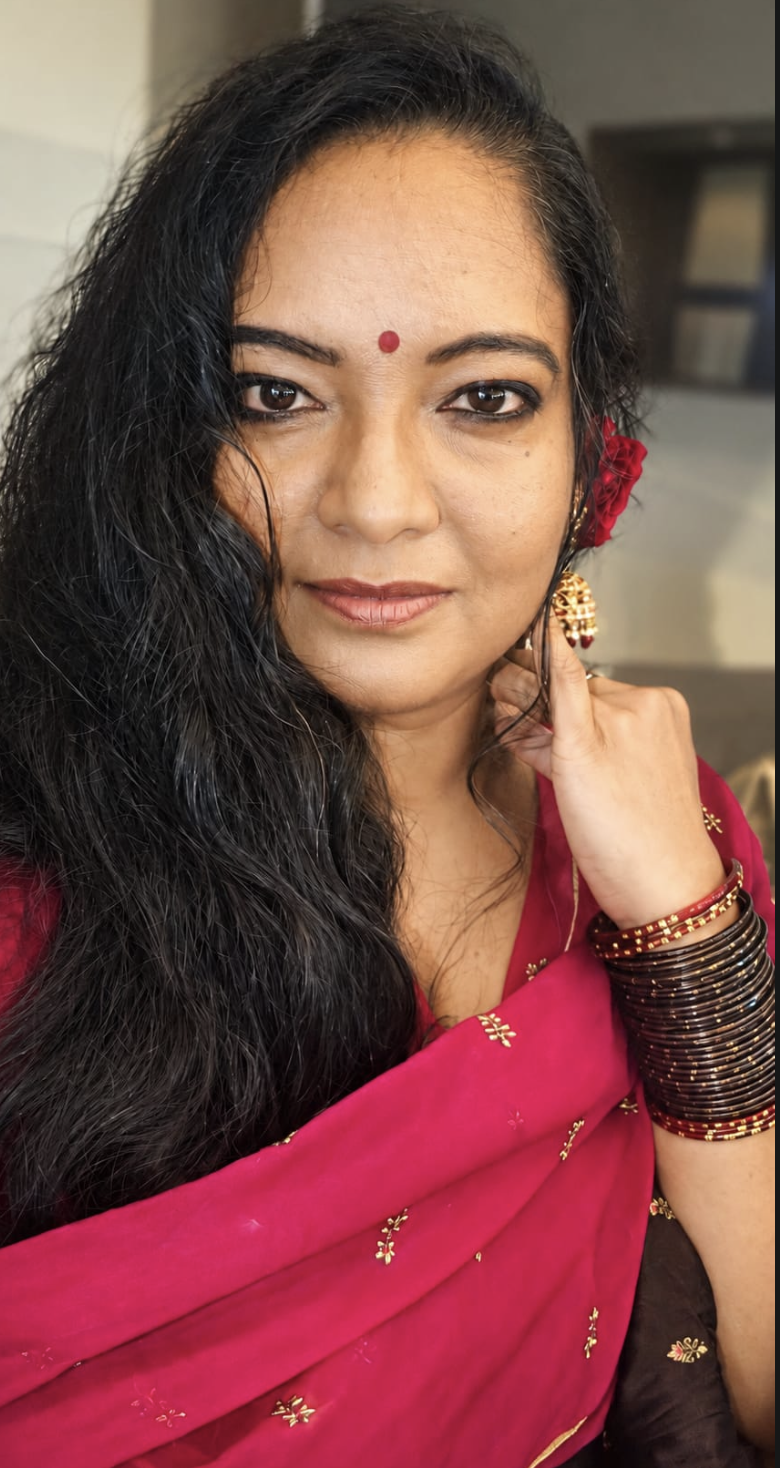
I Asked AI to Make My Photo Better. But Did It Keep Me?

I have been playing with AI photo editing lately, and this time I decided to try something with my own photo. Not to create a new person, not to change my face, just to see what AI would do with a simple request.

I had a photo of myself wearing a salwar. Nothing special about the photo, just a regular picture. I wanted to use it for my Facebook profile, so naturally, I started thinking about editing it.

I have been using Lightroom for years. I enjoy photography, and editing photos is something I like doing myself. I know how to adjust the lighting, colors, shadows, and skin tones. Sometimes I spend quite a bit of time on one photo, making small changes until I feel happy with it.

So I edited the photo in Lightroom, the way I normally would. That became my second photo.

Then I thought, why not give the same original photo to AI and see what happens? I didn’t write a long prompt or explain every little thing I wanted changed. I simply typed:

“Make it better for fb profile photo, don’t change my face or person.”

That’s it. One sentence.

And AI gave me the first photo.

Now, looking at all three photos together, I started noticing the differences. The last photo is the original, with no editing at all. The middle one is my Lightroom version, where I made the adjustments myself. And the first one is the AI version.

One thing I noticed immediately was my under-eye area. I have always had this issue, mostly under one eye. I have tried to find that magic cream that is supposed to make everything look better, but I still haven’t found it. Apparently, AI didn’t need a cream. It just fixed the appearance in the photo!

Of course, that doesn’t mean my under-eye problem disappeared in real life. I still have the same face when I look in the mirror. But it was interesting to see how easily AI could make those little changes in a photograph.

What surprised me wasn’t just the under-eye correction. It was how quickly AI did the whole thing. When I edit a photo manually, I make decisions about the brightness, shadows, colors, and every adjustment. With AI, I gave it one instruction and let it decide what would make the photo better.

But that also made me think about something. When we ask AI to make our photos better, what does better actually mean? Is it better lighting? Better skin? Fewer wrinkles? Or does AI have its own idea of how we should look?

I specifically told it not to change my face or the person. That part was important to me. I didn’t want to look like somebody else. I wanted the photo to look like me, just with a few improvements.

I kept comparing the three versions. My original photo was simply me, exactly as the camera captured me. My Lightroom version was how I wanted to edit myself. The AI version was how AI interpreted my request.

And after all that comparing, guess which one I picked?

The AI version.

Yes, I already updated my Facebook profile photo with it.

Does that mean I’m going to stop using Lightroom? No. I still enjoy editing my own photographs, and I don’t think AI replaces everything we do as photographers. Sometimes I want complete control over an image, and sometimes I just want a good result without spending too much time on it.

What I found interesting was that I could get a result I liked with such a simple prompt. I didn’t need to learn another editing technique or spend time moving sliders around. I just told AI what I wanted.

At the same time, I know the AI photo is still an edited version of me. It’s not exactly what the camera captured, just as my Lightroom photo isn’t exactly the original either. The difference is who made the editing decisions.

Looking at these three photos made me think about how much photo editing has changed. We went from darkrooms to Photoshop and Lightroom, and now we’re simply talking to AI.

And I’m sitting here wondering how many more things we’ll be doing this way in the next few years.

For now, I’m happy with my new Facebook profile photo. And I’m still looking for that magic under-eye cream. AI can fix my photo, but I need something that works when I’m not looking at a screen!

So tell me, looking at these three photos, which one would you choose?

Photo 1 – AI edited
Photo 2 – My Lightroom edit
Photo 3 – Original, without editing

Would you choose the original, do your own editing, or let AI do the work?

One Pumpkin, Two Cultures, and the Mystery of the Evil Eye

An October reflection on Halloween, Indian Drishti traditions, a few strange coincidences, and two familiar faces with a spooky twist.

October is here, and pumpkins are everywhere!

Every grocery store, every neighborhood, every front porch seems to have one. Some are beautifully carved, some have scary faces, and some are just sitting there looking pretty. Then there are the skeletons hanging from trees, ghosts floating in front yards, and houses decorated as though someone is preparing to welcome an entire ghost family.

After living in America for so many years, I have gotten used to Halloween. I enjoy watching how creative people get with their decorations. But this year, looking at all those pumpkins, something funny crossed my mind.

In America, people put pumpkins outside their houses for Halloween. Back in India, we also put pumpkins outside our houses, but for Drishti!

Same pumpkin, completely different purpose.

Isn’t that something?

In some Telugu households, we hang a pumpkin in front of the house to ward off the evil eye. We also have a tradition of rotating a pumpkin as part of a ritual to remove Drishti.

Here in America, people carve scary faces into pumpkins and put lights inside them. Back in India, we have our own frightening-looking Dishti Bommalu outside houses and buildings.

I started wondering how two cultures, thousands of miles apart, ended up using pumpkins in such interesting ways.

And then I remembered something that happened recently at my house.

But before I tell you about my tea — yes, this story involves my tea! — I wanted to understand where Halloween actually came from.

So, Where Did Halloween Come From?

Growing up in India, Halloween wasn’t something we celebrated. We had plenty of our own festivals, traditions, and stories about spirits. Halloween was something I came to know more about after living in America.

Today, it is all about costumes, candy, pumpkins, and decorations. But Halloween has a much older history.

One of its important historical roots is the ancient Celtic festival called Samhain, celebrated more than 2,000 years ago in parts of what are now Ireland and Britain.

Samhain marked the end of the harvest season and the beginning of winter.

Think about life back then. No electricity, no heaters, no grocery stores where you could buy whatever you needed. Winter meant darkness, cold weather, and uncertainty.

In later accounts of Celtic traditions, Samhain was associated with the belief that the boundary between the living and the spirit world became thinner around this time of year.

People had stories and rituals connected to spirits and the unknown.

As Christianity spread, older seasonal traditions interacted with Christian observances. November 1 became associated with All Saints’ Day, and the evening before it was called All Hallows’ Eve.

Over time, All Hallows’ Eve became Halloween.

Irish and Scottish immigrants brought Halloween customs to America, where the celebration gradually changed into what we see today.

What I find amusing is how something once associated with fear and the supernatural has become such a fun holiday.

Now we dress our children as ghosts, take pictures, and send them out to collect candy!

Imagine explaining that to someone living 2,000 years ago.

And How Did the Pumpkin Get Involved?

This part surprised me.

The original Halloween lanterns weren’t even made from pumpkins.

In Ireland and Scotland, people carved faces into vegetables such as turnips. These lanterns became associated with local folklore, including stories about a wandering character called Stingy Jack.

When the tradition reached North America, pumpkins were much more readily available and easier to carve.

So pumpkins replaced turnips, and the jack-o’-lantern became one of Halloween’s most recognizable symbols.

Now, whenever I see those carved faces glowing on American porches, I can’t help thinking about our Indian traditions.

We also have frightening faces displayed outside buildings, especially the Dishti Bomma (దిష్టి బొమ్మ).

And in some Telugu traditions, a pumpkin itself is used for protection from Drishti.

Of course, Halloween pumpkins and Indian Drishti pumpkins don’t have a documented common origin. They come from different cultural histories.

Still, I find it interesting that an ordinary vegetable can have such different meanings.

For one family, a pumpkin is a Halloween decoration.

For another, it is something used in a ritual to protect the home.

And for someone like me, who grew up in India and has spent many years in America, it becomes a reason to start asking questions.

Drishti — That Familiar Word From Our Childhood

If you grew up in a Telugu family, you probably heard this expression many times.

“దృష్టి తగిలింది!”

“Drishti tagilindi!”

Something goes wrong, and someone immediately wonders whether it was Drishti.

A new house, a new car, a successful business, or even a happy occasion can bring up the subject.

We hang lemons and chilies. Some families use pumpkins. Others display a Dishti Bomma.

The idea is that someone’s envy, excessive admiration, or negative attention might bring misfortune.

I don’t know how many of us actually stop to think about these customs while growing up. We see our elders doing them, and they become part of everyday life.

What is interesting is that the evil eye isn’t only an Indian belief.

In Turkey, people use the familiar blue Nazar amulet. Similar beliefs are found in Greece, the Middle East, Mediterranean cultures, and many other places.

Different objects, different rituals, but often the same concern: can another person’s attention somehow affect our happiness or good fortune?

Science hasn’t found evidence that a person’s gaze can cause supernatural harm.

But knowing that doesn’t necessarily erase the stories we grew up hearing.

Sometimes all it takes is one unexpected incident to bring those stories back.

Which brings me to my tea.

Now, Let Me Tell You About My Tea!

Anyone who has visited my house knows that I enjoy having people over.

I love sitting with friends and family, sharing food, having conversations, and making people feel comfortable. I enjoy those moments when everyone is sitting around talking, and nobody is watching the clock.

And my tea is usually part of the experience.

I make tea almost every day, often twice a day for my husband and me. Over the years, it has become something friends and family look forward to when they visit.

We have had so many conversations over cups of tea that I sometimes think my kitchen has heard more stories than anyone else!

Recently, we had family visiting from India.

We don’t get to spend much time together, so we wanted to make the most of their visit. We picked them up from the airport, took them around the Bay Area, spent time together, and introduced them to our friends.

Our friends were wonderful, too. They welcomed our guests and even invited us over for dinner.

I enjoyed seeing everyone together.

For me, welcoming someone into our home is not about what they bring or what we get in return. I have always believed that relationships are worth making an effort for, even when they don’t always turn out the way we hope.

I like people to leave our home with good memories.

Anyway, during this visit, something unusual happened.

My tea spoiled!

Now, I know what you are thinking.

“So what? Tea can spoil!”

Exactly!

But I have been making tea for so many years that I could practically make it with my eyes closed. I couldn’t remember having this happen before.

I stood there wondering what had gone wrong.

Was it the milk? Did something change in the ingredients? Did I do something differently without realizing it?

I didn’t have an answer at that moment.

Then another incident happened.

I was taking photographs when I hurt my left thumb. It became swollen and painful.

Photography is something I do all the time. Whether it is professional work, family gatherings, or simply capturing a moment, I am very comfortable with a camera.

So the injury caught me by surprise.

First, my tea. Then, my thumb.

Two small incidents that could happen to anyone.

But because they were unusual for me and happened close together, a familiar word entered my mind.

Drishti?

And that made me think.

Here I am, living in America, surrounded by technology, science, and artificial intelligence, and suddenly I am remembering the same word I heard growing up in India.

Why?

I didn’t have any reason to believe that someone had caused those incidents or wished anything bad for us. Tea can spoil for perfectly ordinary reasons, and people can get hurt while doing familiar activities.

Still, I found it interesting that my mind went to Drishti at all.

I began wondering whether this is how some superstitions survive.

Not necessarily because we are convinced they are true, but because they have been part of our thinking for so long.

Why Do We Look for a Connection When Something Goes Wrong?

Have you ever noticed how our minds work?

When everything goes normally, we don’t think much about it.

I make tea every day. Nothing unusual happens. I don’t stop to wonder why the tea turned out perfectly.

I take photographs all the time. Nothing happens. I don’t think twice about it.

But when something unexpected happens, suddenly I want an explanation.

And if two unusual things happen close together, my mind starts connecting them.

Psychologists have studied this tendency. Our brains naturally look for patterns, and sometimes we see relationships between events that may have nothing to do with one another.

There is even a term for it: illusory correlation.

That sounds very scientific, doesn’t it?

But the experience itself is so ordinary.

Something goes wrong, and we ask, “Why now?”

Depending on where we grew up, the answer that comes to mind may be different.

In India, someone might say Drishti.

Elsewhere, someone might call it bad luck.

Another person might simply shrug and say, “These things happen.”

I think our emotions also play a role.

When relationships or situations are complicated, we may notice things more closely. An ordinary coincidence can suddenly seem meaningful.

That doesn’t mean there is an invisible force behind it.

It means we are human, and our minds carry memories, feelings, and experiences along with facts.

Sometimes We Forget That Relationships Are Complicated Enough

There is one part of the Drishti belief that makes me a little uncomfortable.

The idea that someone’s jealousy or negative thoughts can cause bad things to happen to us.

How do we know what another person is thinking?

We really don’t.

Someone may be quiet, distant, or different from us. That doesn’t automatically mean they are jealous or wishing us harm.

And if something unfortunate happens afterward, it doesn’t prove anything about that person.

Over the years, I have learned that relationships don’t always work the way we wish they would.

Sometimes we want to be closer to people than they seem to want to be with us. Sometimes we make an effort and don’t receive the same effort in return.

It can be disappointing.

But I don’t want those disappointments to decide how I treat people.

I would rather welcome someone warmly because that is what I believe in, not because I am expecting them to behave a certain way.

At the same time, being generous doesn’t mean we have to ignore our feelings or forget our boundaries.

We can be kind and still be realistic.

And we certainly don’t need to blame people for a spoiled cup of tea!

From Halloween Ghosts to Our Own Chandramukhi and Arundhati

While thinking about Halloween and Drishti, another thought came to mind.

We Indians don’t really need to borrow scary characters from Hollywood. Our movies have given us plenty of sleepless nights already!

Remember Chandramukhi?

That unforgettable expression, those intense eyes, the dramatic music, and the mysterious mansion?

And what about Arundhati?

Jejamma sitting on her throne, looking powerful enough to make even the ghosts think twice before approaching her!

I remember how these movies made supernatural stories so fascinating. Even people who don’t believe in ghosts can get completely absorbed in them.

Chandramukhi is especially interesting because it explores the relationship between fear, belief, and psychology. Arundhati, on the other hand, takes us into a world where supernatural forces are real within the story, and courage becomes the weapon against them.

Two different approaches to the unknown.

And isn’t that similar to how we react to things in real life?

Sometimes we look for a logical explanation. Other times, the stories we grew up hearing are the first things that come to mind.

So, with Halloween approaching, I thought, why should Hollywood have all the fun?

Why not bring a little Telugu cinema into my October celebrations?

And that is how two new characters entered my world.

Meet Praveendhati and Praveenamukhi!

[Insert the square “Meet Praveendhati & Praveenamukhi” cinematic poster here.]

Yes, both are me!

Meet Praveendhati, inspired by the powerful Jejamma from Arundhati, and Praveenamukhi, inspired by the unforgettable Chandramukhi.

One sits on her throne with the confidence of a queen.

The other looks like she has a few unfinished conversations from another lifetime!

And both have my face.

I had so much fun imagining myself in these two dramatic characters. With a little creativity and AI, I could step into the atmosphere of the movies I remember and give them my own playful twist.

As someone who loves photography and visual storytelling, I find this side of technology fascinating. We can take an idea from our imagination and turn it into something we can actually see.

Of course, these are just creative Halloween interpretations, not a claim that I have suddenly developed supernatural powers!

Although, if Praveenamukhi could make my tea perfectly every time, I wouldn’t complain.

And if Praveendhati could protect my thumb while I am taking photographs, that would be even better!

Jokes aside, creating these characters made me think about something else.

Why do we enjoy watching ghosts and supernatural stories on a screen, but when something unexplained happens in our own lives, we sometimes become uncomfortable?

We know we are watching fiction.

Yet those stories still connect with fears, memories, and beliefs that feel familiar.

Maybe that is why Indian horror movies stay with us long after the credits roll.

They don’t just show us frightening faces. They borrow from the stories, rituals, and questions that many of us grew up with.

And for this Halloween, Praveendhati and Praveenamukhi are my little tribute to that world of imagination.

Are Halloween and Drishti Really That Different?

Coming back to Halloween, I started looking at the decorations a little differently.

In America, people carve frightening faces into pumpkins and display them outside their homes.

In India, we have frightening-looking Dishti Bommalu, and in some traditions, pumpkins are hung outside houses or rotated in rituals to remove Drishti.

There are important differences.

Modern Halloween is mostly about celebration and entertainment. Indian Drishti rituals are often performed with a genuine belief in protection.

Their histories are different, and we shouldn’t assume they are directly connected just because both involve pumpkins.

But both made me think about how people respond to the unknown.

Long ago, people had fewer scientific explanations for illness, accidents, changing seasons, and natural events. Stories about spirits and unseen forces became part of how communities understood the world.

Today, we know much more.

We understand why milk curdles. We know that injuries have physical causes. We have scientific methods to investigate things that once seemed mysterious.

Yet some old beliefs remain with us.

Maybe because traditions are not just about explanations.

They are also about memories.

About our parents and grandparents.

About the homes we grew up in.

About the things we saw people doing long before we were old enough to question them.

And when we move to another country, those memories don’t disappear.

We carry them with us.

Sometimes we don’t even realize it until something reminds us.

Like a pumpkin on an American doorstep.

Or a Telugu horror movie character appearing in our imagination during Halloween!

A Pumpkin Is Just a Pumpkin. Or Is It?

I find it amusing that the same vegetable can mean so many different things.

In my kitchen, a pumpkin is food.

In an American front yard during October, it is a Halloween decoration.

In some Indian homes, it becomes part of a Drishti ritual.

The pumpkin itself hasn’t changed.

We have given it different meanings.

And perhaps that says something about human beings.

We are constantly giving meaning to the world around us.

An object becomes a symbol.

A coincidence becomes a story.

A family practice becomes a tradition.

And after enough generations, we sometimes forget to ask where it all began.

That is why I enjoy learning about the history behind these customs.

Not because I want to prove one culture right and another wrong.

But because I find it fascinating how people in different parts of the world can be so different and yet share some very familiar ways of thinking.

This Halloween, I Will Be Looking at Pumpkins Differently

As October 31 gets closer, the Halloween decorations will only get bigger and more creative.

I will enjoy seeing the pumpkins, costumes, and decorated houses.

But I know that this year, every time I see a pumpkin outside someone’s house, I will probably remember our Indian Drishti traditions.

And perhaps I will smile at the thought of how one pumpkin can connect two completely different cultural experiences in my mind.

As for my tea, I am still making it.

And I am still taking photographs.

The spoiled tea and injured thumb were unexpected, but they gave me something interesting to think about.

Would I say it was Drishti?

I don’t know why those two incidents happened so close together, but I have no evidence that the evil eye had anything to do with them.

What I do know is that our childhood beliefs have a funny way of returning when we least expect them.

We can question those beliefs without disrespecting our traditions.

We can appreciate the stories our elders told us without accepting every explanation.

And we can enjoy another culture’s celebrations while noticing little connections to our own.

That, to me, is one of the interesting parts of living between India and America.

You get to see the world from more than one perspective.

And sometimes, all it takes is a pumpkin to get you thinking.

Next time my tea spoils, though, I think I will check the milk before worrying about Drishti!

Looking Beyond What We See

I have always believed there is more than one way to look at the world. Sometimes, changing our perspective helps us discover something new in things we have seen all our lives.

That curiosity is also part of what inspires Pravision. Through photography, creativity, storytelling, and the ideas we share, I hope to encourage people to look beyond what they see at first glance.

Creating Praveendhati and Praveenamukhi was another way of exploring that curiosity. It brought together my love of Indian cinema, photography, storytelling, and the creative possibilities of AI.

After all, sometimes a pumpkin is not just a pumpkin. It is a story waiting to be discovered.

And sometimes, behind a familiar face, there are two completely different characters waiting to come out!

Happy Halloween! 🎃

With love, a little curiosity, and just a touch of Telugu cinema drama,

— Praveena Jogi

Sharing stories, perspectives, and creative ideas through Pravision.


What About You?

Did you grow up seeing pumpkins hung outside houses to ward off Drishti? Have you seen people rotate a pumpkin to remove the evil eye?

And if you live in America, have you ever looked at a Halloween pumpkin and thought about our Indian traditions?

One more question for my Telugu movie lovers.

If you had to choose, would you rather be Chandramukhi or Jejamma from Arundhati?

And tell me, which of my Halloween characters do you like better — Praveendhati or Praveenamukhi?

I would love to hear your stories!

A Little More About the History

For anyone curious about the historical background, these are useful starting points:

Indian Drishti practices vary by region and household. The comparison with Halloween is a personal cultural observation, not a claim that the traditions share the same historical origin. Praveendhati and Praveenamukhi are creative, AI-assisted character interpretations inspired by Indian cinema.
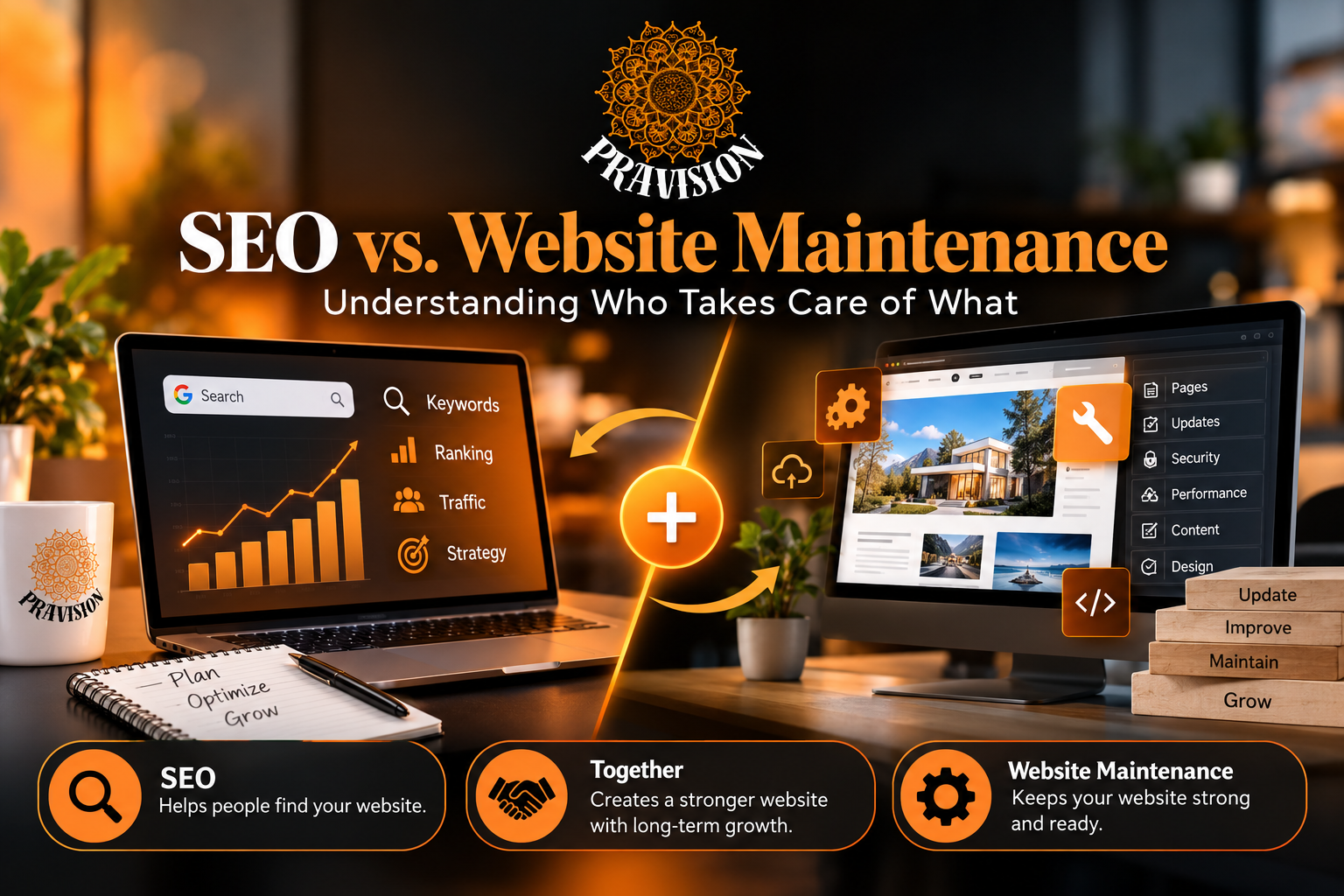
SEO vs. Website Maintenance: Understanding Who Takes Care of What

When you receive an SEO report, you may see recommendations about keywords, content, headings, website speed, page structure, or even technical problems with the website.

A common question is: If it is in the SEO report, isn’t it part of the SEO service?

Not necessarily.

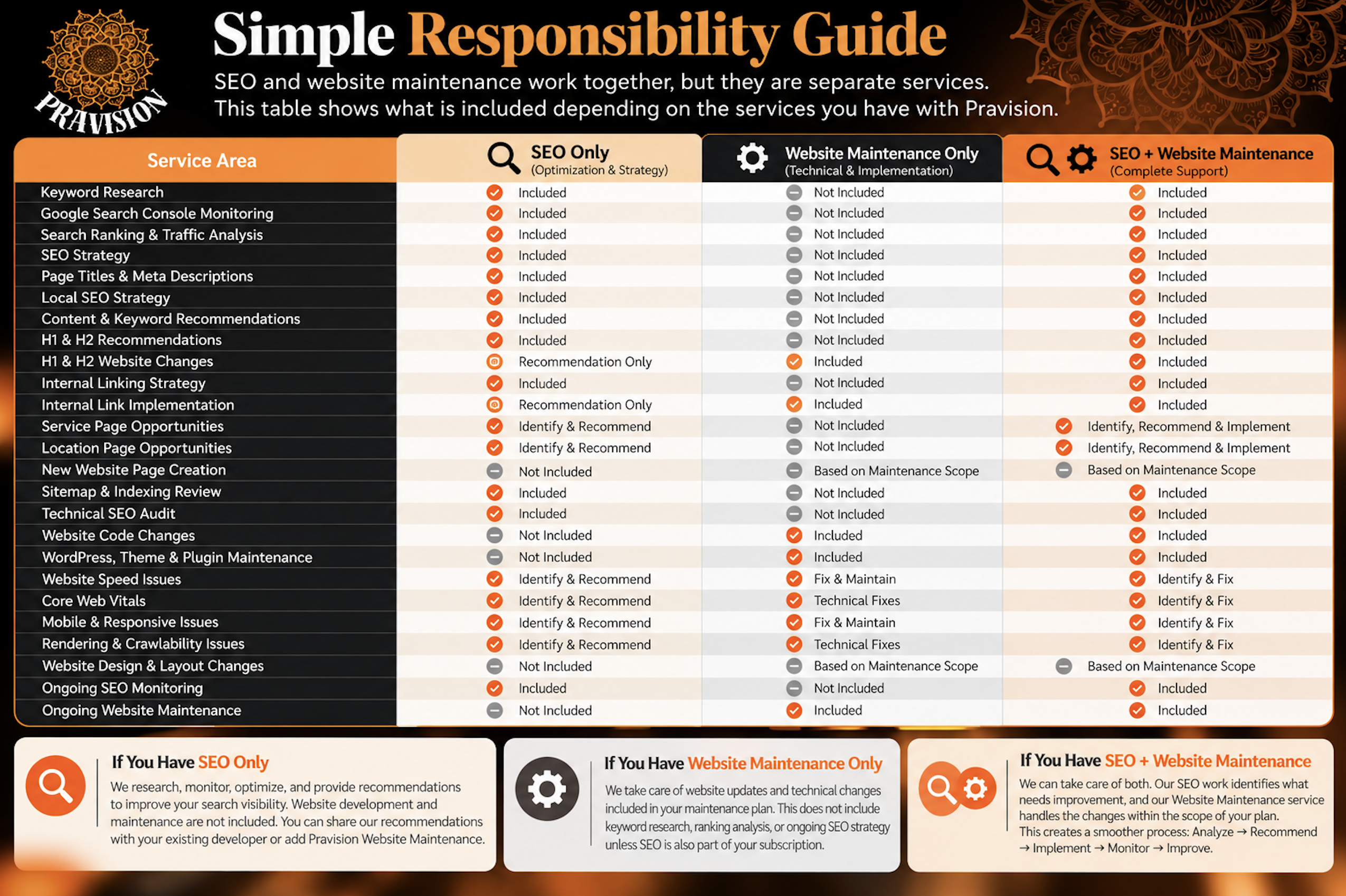
SEO and website maintenance work closely together, but they are two different services. SEO focuses on helping search engines understand your website and helping potential customers find your business. Website maintenance focuses on keeping the website healthy and implementing technical, structural, and content changes when needed.

At Pravision, customers can subscribe to SEO, website maintenance, or both.

When you have both Pravision SEO and Website Maintenance services, we can take care of the SEO strategy as well as the website changes needed to support it.

If you subscribe only to SEO, Pravision will identify SEO opportunities and website issues that may affect your search performance, but website development and maintenance work is not included in the SEO subscription. Those changes will need to be handled by your website developer or through a Pravision Website Maintenance plan.

What Does Pravision SEO Take Care Of?

SEO is about improving your website’s visibility in search engines such as Google.

We look at how your website is performing in search, what potential customers are searching for, which pages Google is finding, and where there are opportunities to improve.

SEO work may include:

  • Keyword research and targeting

  • Google Search Console monitoring

  • Search impressions, clicks, CTR, and ranking analysis

  • Page title and meta description optimization

  • Local SEO strategy

  • Sitemap and indexing review

  • Content and keyword recommendations

  • H1 and H2 heading recommendations

  • Internal linking strategy

  • Image SEO recommendations

  • Competitor and content-gap analysis

  • Identifying opportunities for service and location pages

  • Identifying technical issues that may be affecting search visibility

  • Ongoing SEO monitoring and recommendations

When we find something that can be improved through SEO, we work on that as part of the SEO service.

When we find something that requires changes to the website itself, we will identify and explain the issue.

If Website Maintenance is also part of your Pravision subscription, we can take care of those website changes within the scope of your maintenance plan. If you have SEO only, the website changes will need to be completed separately.

Why Does an SEO Report Find Website Problems?

Because your website is the foundation of SEO.

During an SEO audit, we may find that a page needs better headings, more useful content, stronger internal links, better performance, or a different technical structure.

We may also discover that the business would benefit from new service pages, location pages, FAQs, or other website content.

These findings belong in the SEO report because they can affect search visibility.

However, finding the issue does not always mean that fixing the website itself is included in SEO.

Think of it this way:

SEO identifies what can help your website perform better in search.

Website Maintenance implements changes to the website when technical or structural work is required.

And when you have both services with Pravision, we can manage both sides for you.

SEO Strategy vs. Website Implementation

Here is a simple example.

Suppose SEO research shows that potential customers are searching separately for granite countertops, quartz countertops, marble countertops, and countertop installation.

From an SEO perspective, it may make sense to create individual pages for those services.

Pravision SEO can research the opportunity, determine the keywords, recommend the page titles and headings, and provide direction for the content and internal linking.

Someone still needs to create those pages on the website.

If the customer has Pravision SEO + Website Maintenance, Pravision can handle both the SEO direction and the website implementation based on the scope of those services.

If the customer has Pravision SEO only, we provide the SEO recommendation and direction, while the customer’s website developer or maintenance provider handles the website changes.

With a Pravision SEO-only subscription, we will research, monitor, optimize, and identify opportunities to improve your website’s search visibility.

If our SEO analysis finds an issue that requires changes to your website’s code, design, structure, pages, theme, plugins, or functionality, we will let you know what needs to be addressed.

Website development and maintenance are not included with an SEO-only subscription.

You can share our recommendations with your existing website developer or add Pravision Website Maintenance if you would like us to take care of those changes.

### If You Have Website Maintenance Only

With Pravision Website Maintenance, we take care of website updates and technical changes that are included within your maintenance plan.

Website Maintenance does not automatically include keyword research, ranking analysis, Search Console monitoring, competitor research, or an ongoing SEO strategy unless SEO is also part of your subscription.

### If You Have SEO + Website Maintenance

When you have both Pravision SEO and Website Maintenance, we can take care of both sides.

Our SEO work identifies what needs improvement, and our Website Maintenance service handles the website changes that fall within the scope of your maintenance plan.

This creates a much smoother process:

Analyze → Recommend → Implement → Monitor → Improve

Instead of receiving an SEO recommendation and then having to coordinate with another website provider, Pravision can manage the SEO and website work together.

Some larger projects, such as a complete redesign, custom development, new functionality, or a significant number of new pages, may fall outside the regular maintenance plan. If that happens, we will identify the additional work before moving forward.

What Happens If You Have SEO Only?

If you subscribe to Pravision SEO only, we will continue to monitor, analyze, optimize, and provide recommendations for improving your search visibility.

When we identify a website issue that requires development or maintenance, we will clearly explain what needs attention.

For example, we may tell you:

  • A new service page should be created.

  • A page needs a better heading structure.

  • Website content needs to be reorganized.

  • A technical issue may be preventing search engines from properly reading content.

  • Website performance needs improvement.

These findings and recommendations are part of SEO.

The actual website development or maintenance work is not included in an SEO-only subscription.

You can provide our recommendations to your existing website developer, or you can add Pravision Website Maintenance if you would like Pravision to manage those changes.

What Happens If You Have Both Services?

When you subscribe to Pravision SEO + Website Maintenance, the process becomes much simpler.

Our SEO work can identify what needs improvement, and our website maintenance work can take care of the necessary website changes that fall within the scope of your plan.

Instead of coordinating between separate providers, Pravision can connect the two sides:

Analyze → Recommend → Implement → Monitor → Improve

For example, if SEO identifies that a heading needs to be changed, we can make the website change.

If internal links need to be added, we can implement them.

If a technical website issue is affecting SEO, we can investigate and address it through website maintenance.

If a larger development project is required, such as building several new pages or adding new functionality, we will identify that separately and determine whether it falls within the maintenance plan or requires additional development work.

This keeps the responsibilities clear while allowing SEO and website maintenance to work together.

Why Both Matter

A technically strong website without SEO may look great but still be difficult for potential customers to find.

A strong SEO strategy can also be limited when technical or structural website problems are left unresolved.

That is why the two services complement each other.

SEO helps us understand where the opportunities are.

Website Maintenance helps us make the necessary changes to the website.

When you have both services with Pravision, we can manage that process together.

When you have SEO only, we will continue to identify, optimize, monitor, and recommend, while website development and maintenance remain the responsibility of your website provider.

One Goal, Two Services

Our goal at Pravision is to make responsibilities clear.

We don’t want to simply send an SEO report filled with numbers. We want you to understand what the report means, what Pravision is taking care of, what needs attention on the website, and what the next step should be.

SEO finds and develops the opportunities. Website Maintenance supports the website changes needed to act on them.

And when you have both services with Pravision, we can take care of both sides and keep them working together toward the same goal: a stronger website with better long-term search visibility.


Image Gallery

America’s Drain & Jetting Website Is Live

I’m happy to share another website we designed and developed at Pravision. The new website for America’s Drain & Jetting is officially live.

This was a fun project to work on because we didn’t start with a ready-made template and try to fit the business into it. We created the website around the customer, their services, their logo, and the way they wanted their company to be presented.

The goal was simple. When someone visits the website, it should feel like America’s Drain & Jetting.

We Started With Their Brand

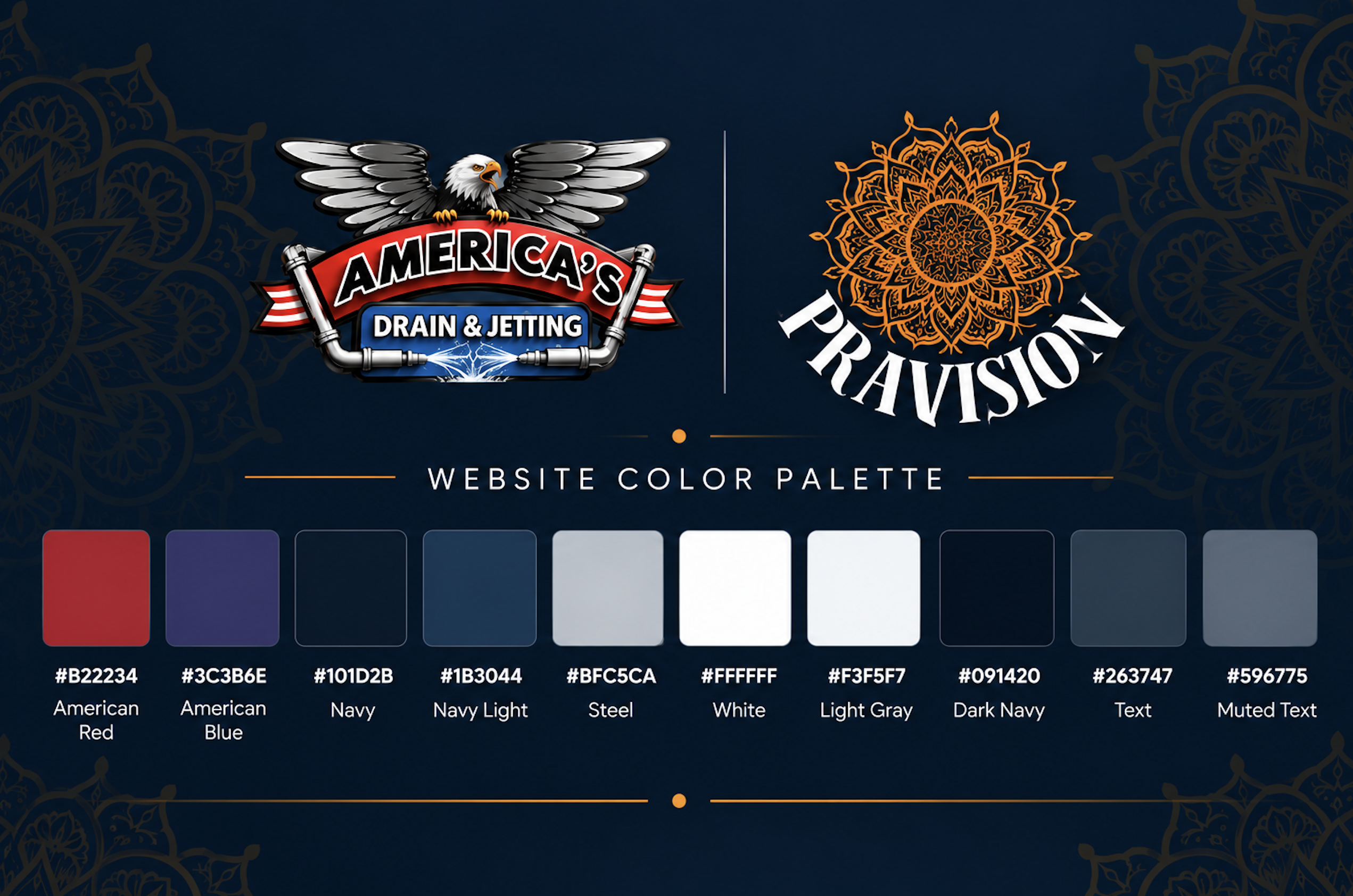
One of the first things we worked on was the color palette.

The customer already had a strong logo with an American theme, so instead of introducing completely different website colors, we built the website colors around their logo.

Here is the palette we used:

You can see these colors throughout the website, from the header and buttons to the backgrounds, calls to action, and smaller details.

Everything works together with their existing logo.

No Template. We Created It for Them.

We did not pick a template and replace the pictures and text.

The website was custom created for America’s Drain & Jetting.

The homepage sections, service presentation, calls to action, header, footer, mobile layout, colors, and overall experience were created around this business.

I like working this way because every business is different. Their website should be different too.

Even Uploading Photos Was Made Easier

One thing that can become frustrating during website development is collecting photos from the customer.

Emailing large files back and forth is not always convenient. Asking the customer to log into WordPress, find the Media Library, and upload everything there isn’t ideal either.

So we made that easier.

Using the Pravision Connector, the customer can upload images directly to their website media.

No additional image upload plugin is needed.

They upload the pictures, and they are available for us to use on the website.

Simple.

Forms Without Another Forms Plugin

We also don’t need to keep adding plugins for every little function.

The website does not need a separate forms plugin just to collect a customer inquiry.

And for us, a form submission shouldn’t end with an email notification.

A form submission can become the beginning of the customer workflow.

With Pravision AI, the information can be captured, an email can be sent directly from the form submission, the lead can be saved to the CRM, and the communication can continue from there.

The Website Is Live. Now What?

This is actually one of my favorite parts.

A lot of people think website development ends when the website goes live.

For us, that is only the beginning.

Websites need maintenance. Content changes. Plugins need updates. Themes need updates. Leads come in. Emails need to go out. SEO needs attention. Sometimes the website needs to go into maintenance mode. Sometimes you just need to change something in the header or footer.

Normally, a business owner may have to go into several different places to handle all of this.

That is what we are changing with Pravision AI.

From Pravision, the customer can handle things like website maintenance, form submissions, CRM information, emails from form submissions, email monitoring and replies, header and footer changes, maintenance mode, SEO, .htaccess, sitemap settings, plugin updates, theme updates, and more.

And the customer doesn’t have to do all of this themselves.

They have a choice.

They can use Pravision AI and manage their website themselves, or they can hire us to take care of it for them.

Because sometimes a business owner doesn’t want to spend time updating plugins, changing website content, checking forms, or working on SEO.

They want to run their business.

And that is exactly the point.

More Than Website Development

This is what Pravision is becoming.

We still love designing and developing websites, but we don’t want to stop at handing over a website and saying, “It’s live.”

We want to make what happens after the launch easier too.

Build the website.

Connect the business.

Manage it from one place.

And let the business owner focus on the business.

America’s Drain & Jetting is now officially live, and I’m very happy to see this project out in the world.

Visit America’s Drain & Jetting

Designed and developed by Pravision LLC

Proudly based in Livermore, CA

The Compass We Forget in the Sunshine and Why Real Integrity Belongs in Every Season

Wait a second—are you wondering if this is even possible? You might be asking yourself, “Can a person really be that blind to their own actions until trouble hits?”

Believe me, it happens to all of us. We are ordinary humans with everyday morals. In the era we live in, both sides—the light and the dark, the good and the bad—coexist right inside us. (We can save the deep dive on how these dual forces live within us for another day; for now, let’s keep our focus on the compass.)

When life is good, the sun is shining, and everything seems to be going our way, we rarely look down at the inner compass in our hands. When we are winning, convenience easily replaces conscience. We might cut a corner, turn a blind eye to an unfairness, or quiet that inner voice telling us to take the high road. We tell ourselves, “Whatever I’m doing is fine—look how well things are going.” In those moments, unrighteousness (Adharma) hides easily behind the glitter of success, and true moral duty (Dharma) is nowhere in the picture.

The Sudden Search for Fairness

The shift happens when the weather turns.

When a storm hits, when plans fall apart, or when someone else treats us unfairly, our perspective changes instantly. The very person who ignored the high road during their rise suddenly becomes a strict defender of fairness. In our difficult times, we remember Dharma vividly because we need it to protect us.

It isn’t that we forget what is right when life is good—it’s that we don’t think about Dharma until we are the ones getting hurt.

The Lessons of the Battlefield: Karna’s Question

This human tendency isn’t new; it has been part of our story for thousands of years. Think back to the legendary scene on the battlefield of Kurukshetra in the Mahabharata.

Karna is stranded on the ground, unarmed, trying to lift his trapped chariot wheel out of the mud. Lord Krishna tells Arjuna that this is the moment to strike. Shocked, Karna turns to Krishna and asks about Dharma: “How can you guide Arjuna to strike down an unarmed warrior on the ground? Where is the Dharma in this?”

Krishna simply responds with a gentle, knowing smile. He asks Karna: “You speak of Dharma today? Where was your thought of Dharma when a helpless Draupadi was insulted in the court? Where was your Dharma when Abhimanyu was trapped and slain by many? You never remembered Dharma when it was convenient for you—how can you demand its protection only when your life is on the line?”

That battlefield scene is the ultimate mirror of the human condition. When we are doing wrong or benefiting from an unfair situation, Dharma isn’t even in our minds. But the second someone does something wrong to us, Dharma is the first thing we demand.

Who Answers Our Question Today?

During the Mahabharata, Lord Krishna was right there on the chariot to answer Karna’s question. But whom do we have today? Can we ask that question to anyone around us? If someone finds themselves in Karna’s shoes today, would they even dare to ask out loud, “Where is the Dharma?”

The truth is, the best person to ask is the one looking back at you in the mirror.

Inside every single person lives an inner Krishna—our consciousness, our quiet inner truth. Before demanding fairness from the world when things go wrong, we have to stand before our own inner Krishna and be completely truthful with ourselves. We must ask:

  • “Have I looked for Dharma in all aspects of my life, or am I only searching for it now because I am hurting?”

  • “Did I uphold fairness when I had all the power, or only now that I am vulnerable?”

Choosing Your Compass Today

The inspiring truth is that you don’t have to wait for a crisis to hold onto your values.

Real strength isn’t using moral principles as an emergency shield only when things go wrong. True nobility is choosing to look at your compass while you are winning.

  • In Your Work & Life: Measure your success not just by the victory, but by the dignity of the path you took to get there.

  • In Your Relationships: Practice kindness, fairness, and truth even when you hold all the power and nobody is watching.

  • In Everyday Moments: Let your inner compass guide you when the road is completely clear, not just when you are stuck in the mud.

When you live with alignment, honesty, and care during your best days, you build a foundation that no storm can shake. Difficult times may still come—they do for everyone—but when they arrive, you won’t need to scramble for Dharma. It will already be right there inside you, giving you an unshakable peace.


Image Gallery

The Story of Pravision

Reimagining Success for Local & Scaling Businesses

Let’s face it: running a business today means paying a quiet, exhausting “app tax.” Most founders end up drowning in a sea of disconnected tools—switching between different software for their website, CRM, scheduling, bookkeeping, and marketing just to get through the morning.

Pravision was built to end that daily struggle, replacing software bloat with a clean, unified AI operating system that lets you focus on what actually matters.

2020–2021: The COVID Crisis & The Roots of Websiteistic

The story of Pravision started in 2020 when the COVID-19 pandemic hit. As lockdowns swept across California, local brick-and-mortar storefronts were forced to shut their doors overnight. Small business owners were left scrambling to figure out how to get online without clear guidance, technical skills, or huge budgets.

Seeing her community hurting, Praveena Jogi—a tech innovator with over 20 years of digital experience—decided to step in.

┌──────────────────────────────────────────────────────────────┐
│ PRAVEENA JOGI'S PHILOSOPHY │
│ │
│ "Deeply inspired by her father’s core value: │
│ 'Always the giving hand, not the taking hand.'" │
└──────────────────────────────────────────────────────────────┘

Driven by that spirit of giving back, Praveena founded Websiteistic in 2021. The mission was simple: provide local business owners with custom web development, clean branding, and solid SEO so they could survive the lockdowns and stay connected with their customers.

Rooted in Livermore, CA: From Wine Country & Culture to World-Class Tech

Pravision was born in Livermore, California, a unique city situated at the easternmost edge of the San Francisco Bay Area. Often recognized for its rich agricultural heritage, Livermore holds a distinctive place in California’s story:

  • 🍷 California’s Oldest Wine Region: Long before Silicon Valley became the tech capital of the world, the Livermore Valley was established in the 1840s as one of California’s premier wine-growing regions, home to historic vineyards like Wente and Concannon.

  • ⚛️ A Hub of Innovation & Science: Beyond its picturesque vineyards, Livermore is globally famous as a center of scientific discovery. It is home to the world-renowned Lawrence Livermore National Laboratory (LLNL)—where heavy chemical element Livermorium (Lv) was named in honor of the city—and Sandia National Laboratories.

  • 🛕 Spiritual & Cultural Heritage: Livermore is home to the Shiva-Vishnu Temple (Hindu Community and Cultural Center). Established in 1977, this architectural masterpiece features traditional South Indian-style gopurams and serves as a vibrant spiritual, educational, and community service hub for thousands of families across the Bay Area.

  • 💡 The Centennial Light Bulb: Demonstrating a spirit of lasting endurance, Livermore is home to the famous Centennial Light Bulb at Fire Station No. 6, which has been burning continuously since 1901—earning a place in the Guinness World Records as the longest-burning light bulb in history.

It was this exact blend of western community values, rich local heritage, and world-class technological innovation that inspired Praveena Jogi to launch Pravision right here in the Tri-Valley.

Living in a city that balances small-town community care with big-tech ambition reinforced Pravision’s core mission: bringing enterprise-grade AI operations to local business owners who deserve modern tools without Silicon Valley price tags.

The Evolution Timeline: From Local Agency to Unified System

As local businesses survived and started growing again, their tech needs got more complex. Praveena realized that entrepreneurs didn’t just need a website—they needed access to enterprise-grade tools on a small business budget to stay competitive.

2021: THE ROOTS
Websiteistic Founded 
└─ Helped local businesses navigate the pandemic with web design, branding, and local SEO.

2024: THE REBRAND
Pravision LLC
└─ Rebranded and expanded to bridge the gap between high-level enterprise tools and everyday small business budgets.

2025: MILESTONE & LAUNCH
CA Small Business (SB) Certification & The Pravision Console
└─ Earned official State of California certification and launched the proprietary AI-first platform, consolidating CRM, marketing, and back-office ops into one dashboard.

What Makes Pravision Different

Proudly based in Livermore, California, Pravision has evolved from a traditional marketing agency into an advanced AI business operating system for Tri-Valley companies and scaling businesses nationwide.

  • 🖥️ The Unified Pravision Console: Ditch software clutter by managing your website, calendar bookings, CRM, marketing automation, and local SEO in a single interface.

  • 📈 Modular “Pay-for-Growth” Model: Get free access to a core client portal for contracts, billing, and profile management, and only pay when you choose to unlock growth engines like sales and marketing automation.

  • 🔗 Easy Tool Connections: Connects smoothly with tools you already rely on, like Stripe, Google, and OpenPhone, to keep your contacts and data synced.

  • 👕 Turnkey Print & Merch Management: Skip the hassle of finding separate print vendors or managing orders yourself. Pravision completely takes care of designing, printing, and delivering custom t-shirts, backpacks, flyers, and pens right to your door.

  • 📲 Custom App Development: Outgrown standard tools? Pravision’s engineering team designs and builds custom web and mobile apps tailored to your specific operations.

The Heart Behind the Brand: Symbolism of the Orange Chakra

The Pravision logo features a vibrant orange chakra. Inspired by the sacred Sudarshana Chakra of Lord Sri Venkateswara (Maha Vishnu)—the celestial disc that protects the righteous, cuts through obstacles, and restores order—the emblem carries deep personal and symbolic meaning:

  • ⚡ Energy & Divine Guidance: The vibrant orange hue symbolizes creative energy, passion, and continuous motion.

  • 🛡️ Protection & Clarity of Purpose: Just as the Sudarshana Chakra represents divine protection and cosmic clarity, Pravision stands as an operational shield for entrepreneurs—cutting through administrative chaos and software obstacles so businesses can thrive.

  • 🔄 Dynamic Growth & Perfection: The circular wheel represents the ongoing pursuit of perfection, innovation, and unstoppable momentum in an ever-evolving digital world.

Recognized by Marquis Who’s Who for standout leadership in technology and sales transformation, Praveena Jogi leads Pravision as CEO & Lead Architect—helping entrepreneurs reclaim their time, strip away software clutter, and build lasting success.

The Hidden “App Tax” Sucking the Time Out of Your Tutoring Business

If you run a tutoring business, your day probably looks something like this:

You check your email on one tab, open Calendly to fix a scheduling conflict between a tutor and a student, log into separate accounting software to check an invoice, switch to VistaPrint to reorder branded pens, and open a spreadsheet to check on a new student inquiry.

By 10:00 AM, you haven’t taught a single student—you’ve just paid the “App Tax.” You’re paying hundreds of dollars a month for multiple software subscriptions that force you to play administrative manager instead of educator.

Whether you run a single local center or manage a network of online tutors nationwide, Pravision was built to eliminate that chaos. Pravision isn’t a collection of third-party integrations taped together—everything is built directly into our unified system out of the box.

  • A Professional Front Door That Enrolls Students: We build custom, high-converting websites directly on the platform. Your site builds instant trust with parents and guides them seamlessly toward booking their first session.

  • Built-in CRM & Bookkeeping: Manage student leads, parent contacts, session notes, billing, and full bookkeeping natively inside Pravision. No separate accounting software, no external CRM subscriptions, and no messy spreadsheets.

  • Built-in Multi-Calendar Scheduling (Ditch Calendly): Stop paying extra monthly fees for standalone booking apps like Calendly. Pravision comes with native scheduling built right in. Connect every tutor’s calendar in real time, let parents book open slots in seconds, and check availability across your entire team automatically.

  • Built-in Print & Merch Operations: Need t-shirts for your staff, branded backpacks for your students, or flyers for local schools? Skip the hassle of finding a local printer or navigating online vendors. Pravision designs, prints, and delivers pens, notebooks, apparel, and marketing materials straight to your door.

  • Custom App Development on Demand: Outgrown standard tools? If you need a fully custom student portal, an interactive learning tool, or a proprietary mobile app tailored to your exact curriculum, Pravision can build and deploy custom software from scratch.

Focus on the Next Generation You didn’t start a tutoring business to juggle software subscriptions and third-party tools. You started it to help students unlock their potential and build confidence.

Pravision handles the tech, operations, and logistics inside a unified system so you can get back to what actually matters: shaping the future.